

Serratus Anterior Exercises: The Muscle Behind Healthy Shoulder Movement
When we talk about shoulder strength and shoulder pain, most people immediately think about the rotator cuff. The rotator cuff matters, but a lot of other muscles have to work properly for the shoulder to move well, and the serratus anterior is one of the biggest. Serratus anterior exercises are one of the most common additions we make to a shoulder rehab program at our River North clinic, because this muscle controls how the shoulder blade moves every time you reach, push, or lift overhead.
The serratus anterior sits along the side of the rib cage and attaches to the inside border of the shoulder blade, or scapula. That location lets it control how the shoulder blade glides along the rib cage.
This becomes especially important when we are reaching, pushing, lifting overhead, or putting weight through our arms.
“Shoulder Blades Down and Back” Is Not Always the Answer
We have all heard the cue. Keep your shoulder blades down and back.
It is useful during certain exercises. It is not how your shoulder is supposed to work all the time.
When you lift your arm overhead, your shoulder blade needs to move. It has to upwardly rotate and posteriorly tilt so your arm can travel through its full range of motion. Pinning the shoulder blade down and back fights the exact movement you are trying to produce.
The serratus anterior is a big part of making that motion happen, which is why it deserves more attention than it usually gets.
What Does the Serratus Anterior Do?
The serratus anterior has a few different jobs, but its main role is helping control the position and movement of the shoulder blade.
It helps with:
- Protraction: Moving the shoulder blade forward and around the rib cage, like when reaching or throwing a punch.
- Upward rotation: Rotating the shoulder blade as you lift your arm overhead.
- Posterior tilt: Helping the shoulder blade tilt appropriately as the arm moves overhead.
- Scapular stability: Keeping the shoulder blade controlled against the rib cage during movement.
The serratus anterior also works closely with the upper and lower trapezius when we lift our arms overhead. None of these muscles work alone, which is part of why shoulder pain is rarely traced back to a single structure.
Serratus Anterior Weakness: Signs and Symptoms
If the serratus anterior is weak or not working well, you may start to see changes in the way the shoulder blade moves.
One of the more obvious examples is scapular winging. Instead of staying relatively flush against the rib cage, the inside border of the shoulder blade begins to lift away from the body.
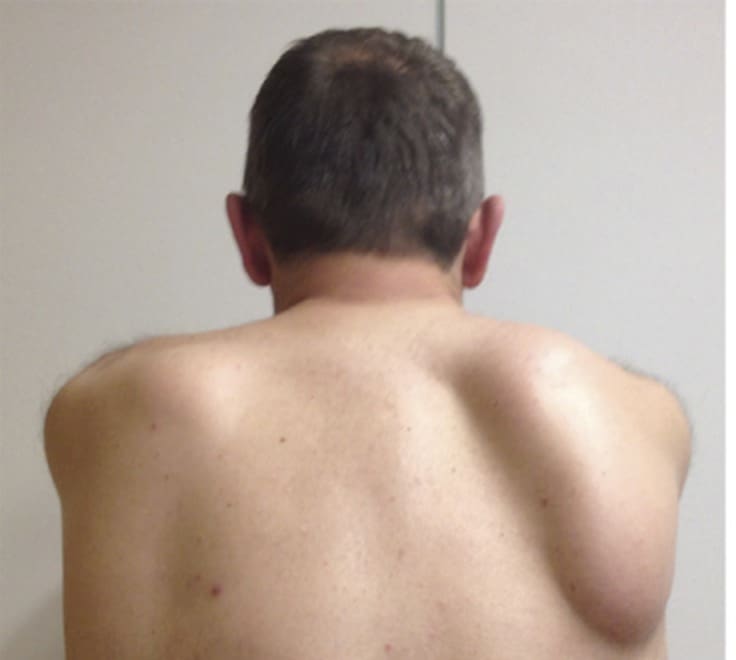
In the clinic, this is usually something a person notices rather than measures. You might see the shoulder blade sticking out in a photo. Someone might mention that one side pops out when you push a heavy door or lower into a push-up.
However, serratus weakness does not always look this dramatic.
Sometimes you may simply notice that the shoulder blade is not moving as well during reaching or overhead movement. Someone may shrug excessively when lifting their arm, have difficulty rotating their shoulder blade upward, or rely heavily on their upper trapezius to compensate.
Over time, altered scapular mechanics can be associated with problems such as:
- Shoulder pain with overhead movement
- Rotator cuff-related shoulder pain
- Scapular dyskinesis
- Shoulder instability
- Difficulty reaching or lifting overhead
- Weakness with pushing movements
- Neck or upper trapezius discomfort
- Scapular winging
This does not mean that every person with shoulder pain has a weak serratus anterior. Shoulder pain is rarely that simple. But it is one of the muscles we should be looking at when evaluating how the entire shoulder complex is moving.
When Winging Needs an Evaluation, Not an Exercise Program
Most of what we see is mild, and it responds well to strengthening. Some of it does not.
Significant winging can follow an injury to the long thoracic nerve, which is the nerve that supplies the serratus anterior. If winging appears suddenly, if it is pronounced, or if it shows up after an illness, a surgery, a fall, or a period of carrying something heavy on your shoulder, that is worth having evaluated rather than working around. A nerve problem is a different problem than a weak muscle, and the exercises below are not the answer for it.
Open-Chain vs. Closed-Chain Serratus Function
Another thing that makes the serratus anterior interesting is that its job changes slightly depending on whether your hand is moving freely or planted against something.
Open-Chain Serratus Function
An open-chain movement means that your hand is free to move.
Think about:
- Reaching forward
- Throwing a ball
- Punching
- Lifting something overhead
- Performing a cable punch
During these movements, the serratus anterior helps move the shoulder blade around the rib cage.
If you reach as far forward as you can, your arm does not create all of that movement by itself. Your shoulder blade also travels forward around your rib cage, and the serratus anterior helps create that extra motion.
The same thing happens when you reach overhead. The serratus helps rotate and tilt the shoulder blade so the arm can continue moving upward.
Closed-Chain Serratus Function
Closed-chain movements are a little different, because now the hand is fixed against something.
Think about:
- A plank
- Push-up
- Quadruped position
- Bear crawl
- Pushing against a wall
Your hand is no longer moving through space. Instead, your body is moving or being supported over your arm.
Now the serratus anterior has to stabilize the shoulder blade against the rib cage while you put weight through the arm.
Think about the top of a push-up. If you let your chest sink toward the floor, your shoulder blades move toward each other and may begin to wing. When you actively push the floor away, the serratus anterior brings the shoulder blades around the rib cage and creates a much more stable position.
For that reason, I like to use both open-chain and closed-chain serratus anterior exercises. We need the muscle to move the shoulder blade, and we also need it to stabilize the shoulder blade when we are loading the arm.
The trunk matters here too. Because the serratus attaches from the ribs to the shoulder blade, it needs a stable rib cage to work from, which is something we cover in more detail here.
8 Serratus Anterior Exercises
There are a lot of ways to strengthen this muscle. The best serratus anterior exercises for you depend on how strong you currently are, which movements bother you, and what you are trying to get back to.
1. Serratus Punch
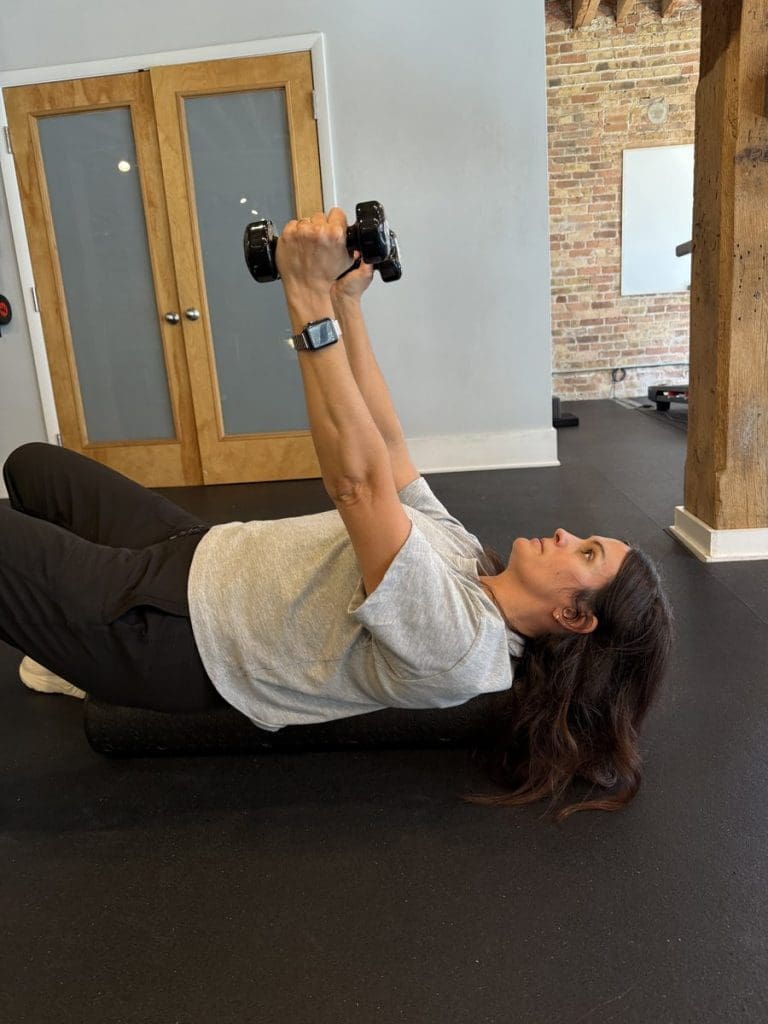
Lie on your back with your arm pointed toward the ceiling. You can start without weight and eventually add a dumbbell.
Keeping your elbow straight, reach your hand toward the ceiling. You should feel your shoulder blade move forward around your rib cage.
Then slowly return to the starting position.
This is a great place to start if someone is having difficulty understanding how to move the shoulder blade without compensating with the rest of the body.
2. Wall Slide

Place your forearms against a wall and gently push into the wall.
While maintaining that pressure, slowly slide your arms upward.
The goal is to let your shoulder blades rotate upward as your arms move overhead instead of forcing them down and back.
You can make this harder by putting a resistance band around your forearms and maintaining slight outward tension on the band while sliding upward.
3. Quadruped Serratus Press
Start on your hands and knees with your elbows straight.
Let your chest sink slightly toward the floor, then push the floor away from you. Your elbows should stay straight throughout the entire movement.
You should feel your shoulder blades move around your rib cage as you push away.
This is a good way to introduce closed-chain strengthening without putting your entire body weight through your arms.
4. Push-Up Plus

The push-up plus is one of my favorite serratus anterior exercises.
Perform a push-up normally. Once you reach the top, keep pushing through your hands so your upper back moves slightly farther away from the floor.
That last little bit of movement is the “plus.”
If a full push-up is too difficult, you can do the exact same exercise against a wall, a countertop, or from your knees.
5. Bear Plank
Start on your hands and knees, then lift your knees a few inches off the ground.
Push the floor away from you and hold that position without letting your chest sink toward the floor.
This is a great progression, because now the serratus has to maintain scapular stability while supporting more of your body weight.
6. Plank Plus
Once a regular plank becomes easy, you can add the same “plus” movement we used during the push-up.
Keep your elbows straight and actively push the floor away from you.
From here, you can progress by adding shoulder taps, reaching, or other movements that force one arm to stabilize while the other moves.
7. Resistance Band or Cable Punch
This is where we start working the serratus more in an open-chain position.
Hold a resistance band or cable and punch forward. At the end of the punch, keep reaching slightly farther so the shoulder blade moves forward around the rib cage.
Slowly control the movement back to the starting position.
You can progress this by adding trunk rotation or increasing the speed of the movement, which works well for someone returning to throwing or other overhead sports.
8. Bear Crawls
Bear crawls are a great higher-level option, because the serratus has to stabilize the shoulder blade while you constantly shift your body weight from one arm to the other.
They also require coordination between the shoulder, trunk, hips, and legs, which makes them a good choice when we are moving from isolated strengthening into more functional movement.
How Many Sets and Reps?
This is the question I get most often, and the honest answer is that it depends on the person. That said, most people do well starting here.
For the movement-based exercises like the serratus punch, wall slide, quadruped press, and push-up plus, two to three sets of eight to twelve repetitions is a reasonable starting point. Move slowly. The goal is to feel the shoulder blade move, not to get through the reps.
For the holding and crawling exercises like the bear plank and bear crawl, work in shorter bouts of twenty to forty seconds and stop while the position still looks good.
Most people can do these most days of the week, because the loads are low and the muscle tolerates frequent work. If you are adding meaningful resistance, two or three days a week with a day in between makes more sense.
The rule that matters more than any of these numbers: stop the set when the quality changes. If the shoulder blade starts to wing, the shoulder shrugs, or you cannot control the movement anymore, that set is over, whether you did four reps or fourteen.
How to Progress Serratus Anterior Exercises
I generally like to think about progression in this order: learn the movement, control the shoulder blade, add body weight, add resistance, add overhead movement, then make it functional.
Someone might start with a serratus punch or wall slide, progress into quadruped and push-up variations, and eventually work toward planks, bear crawls, resisted punches, overhead exercises, or sport-specific movements.
The important part is that the exercise actually looks good.
If adding more resistance causes the shoulder blade to wing, the shoulder to shrug, or the person to lose control of the movement, then adding more weight is not making the exercise better.
Serratus Anterior Exercise FAQs
How long does it take to strengthen the serratus anterior?
Most people notice better control of the shoulder blade within two to four weeks of consistent work. Meaningful strength changes and improvement in symptoms usually take longer. Consistency and quality of movement matter far more than how many repetitions you do.
How do I know if my serratus anterior is weak?
Common signs include the inside border of the shoulder blade lifting away from the rib cage, shrugging when you raise your arm, difficulty pushing overhead, or fatigue in the neck and upper trapezius during reaching tasks. A physical therapist can watch your shoulder blade move and test the muscle directly.
Can serratus anterior exercises help shoulder pain?
They often help when altered scapular mechanics are contributing to the problem. Shoulder pain has many possible sources, so serratus work is usually one piece of a broader program rather than the whole treatment plan.
Should I feel these exercises anywhere specific?
You should feel work along the side of your rib cage and around the shoulder blade. If you mostly feel it in the top of your shoulder or your neck, that is usually a sign the upper trapezius is taking over. Back off the range or the load and slow the movement down.
The Bottom Line
The serratus anterior does a lot more than move the shoulder blade forward.
It controls the shoulder blade during reaching, pushing, weight-bearing, and overhead movement. It also works with the trapezius to create the upward rotation and posterior tilt we need to lift the arm efficiently.
When it is weak or poorly coordinated with the other muscles around the shoulder, we may see winging, excessive shrugging, difficulty with overhead movement, or changes in overall shoulder mechanics.
That is why serratus strengthening should not just mean doing hundreds of serratus punches.
We want to train the muscle in open-chain and closed-chain positions, at different angles, under different loads, and eventually during the actual movements the person needs to perform.
The goal is not just a strong serratus anterior. The goal is a serratus anterior that works with the rest of the shoulder the way it is supposed to.
Working on Shoulder Pain in Chicago
If your shoulder hurts with overhead movement, pushing, or lifting, a full evaluation of how your shoulder blade moves is worth your time. At Dynamic Physical Therapy Chicago in River North, every session is one-on-one with the same doctor of physical therapy, so we can watch your mechanics, adjust in real time, and build a program around the activities you actually want to get back to. Illinois direct access means you do not need a physician referral to start, and we are in network with Blue Cross Blue Shield.
Call 312.643.1555 or request an appointment to get started.