Back: Core Strength and Stability
The most important part of any core stability exercises program is proper form. Training your core muscles with poor technique can do more harm than good. Don’t let that scare you off, though. This post makes core strengthening safe and simple.
Core stability is the balance between stability and mobility in your spine. It is the interaction between your musculoskeletal system, your nervous system, and the external forces acting on your body. Some of those forces are constant, like gravity. Some are expected, like stepping down a stair. Others are unexpected, like getting bumped into on a crowded sidewalk. Whatever the force, your body should be able to react efficiently and effectively.
Why core stability training?
Core stability training can lower your injury risk by improving balance and proprioception, your sense of where your body is in space. Stronger, more enduring muscles protect your joints. Core stability exercises also take pressure off passive structures like ligaments and discs, because your muscles are doing the work of holding you in alignment. Loading those passive structures unnecessarily is a recipe for injury.
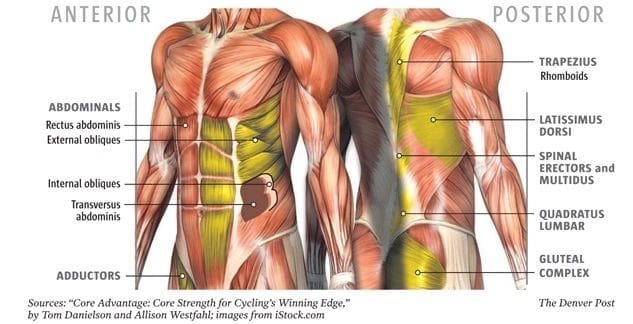
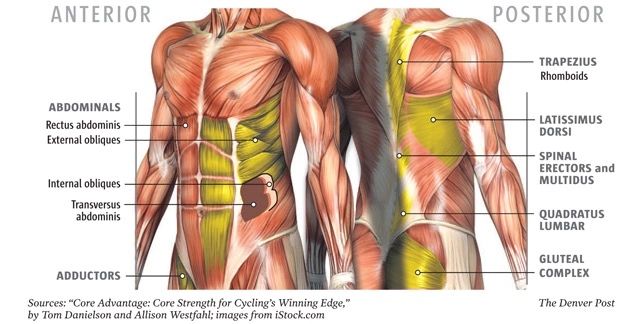
Your core is far more than the rectus abdominis, the “six pack” muscle. It is a coordinated system spanning your abdomen and back, including the transverse abdominis, multifidus, obliques, diaphragm, and pelvic floor. These muscles work together to support a healthy spine.
The core also has to function in tandem with your hip stabilizers, which form your base, and your scapular stabilizers up top. Together these groups maintain posture. Effortless good posture is the goal, but it takes practice and a genuinely strong core. Below you’ll find a beginner core workout along with progressions to build strength and stability over time.
Exercises
Plank progressions:
Planks: Planks are a great way to increase your core stability with no equipment. These are easy to incorporate at all strength levels. Helpful tips to maintain proper alignment in a plank:
- Squeeze your belly button to your spine.
- Squeeze your butt like there is a quarter between your butt cheeks.
- Squeeze your shoulder blades together to help establish a straight line from your ears, to your hips, to your ankles.
Side plank: This plank variation not only works your abdominal complex but also activates your hip abducts (gluteus medius). The glute muscles connect to your pelvis and function as the base of your spine. The base maintains a strong foundation for your spine and core to build off. This is why glute/hip strengthen and stabilization exercise are always a focus in any spinal rehab.
Tips for side planks
- .Follow the same instructions as a standard plank.
- Make sure to pick a progression that you are able to maintain a successful body position without falling.
- Place both feet on the floor if balancing becomes an issue.
Bridging Progressions:
Bridge: Bridge variations are a great way to engage and strengthen your glutes. Your glutes help stabilize the base of your spine and allows for proper alignment throughout the entire spine. Glute engagement and strengthening is a great way to increase stability in your core and spine.
Tips for Bridging
- Maintain the same core alignment as a plank.
- Full foot should be engaged on the floor.
- Push knee out while maintaining heel and big toe engagement on the floor.
- For added challenge add a theraband around the knees and push out when you are lifting up.
Single Leg Glute Bridge:
- Follow the same instructions for a bridge
- Hold one leg up while bridging
- Don’t let the hip drop, maintain a stable core
The YouTube Video attached to this Blog gives you demonstrations on each exercise and how to progress to continue to challenge your strength.
Physical Therapy intervention
A Physical Therapy session focusing on increasing core stability and activation is more than holding a few planks. A skilled provider will assess your ability to engage different components of your core and help train you to make this an automatic response to external forces. This coupled with manual therapy helps expedite the healing process.
If you are experiencing back pain or stiffness, Physical Therapy can help! Please contact us at Dynamic Physical Therapy – Chicago and Follow and Like us on Instagram and Facebook.
Please call (312) 643-1555 or email info@dynamic-PT.com with any questions or to schedule your consultation today.
