

Why Does My Jaw Click? Understanding the Role of the Pterygoid Muscles in TMJ Pain
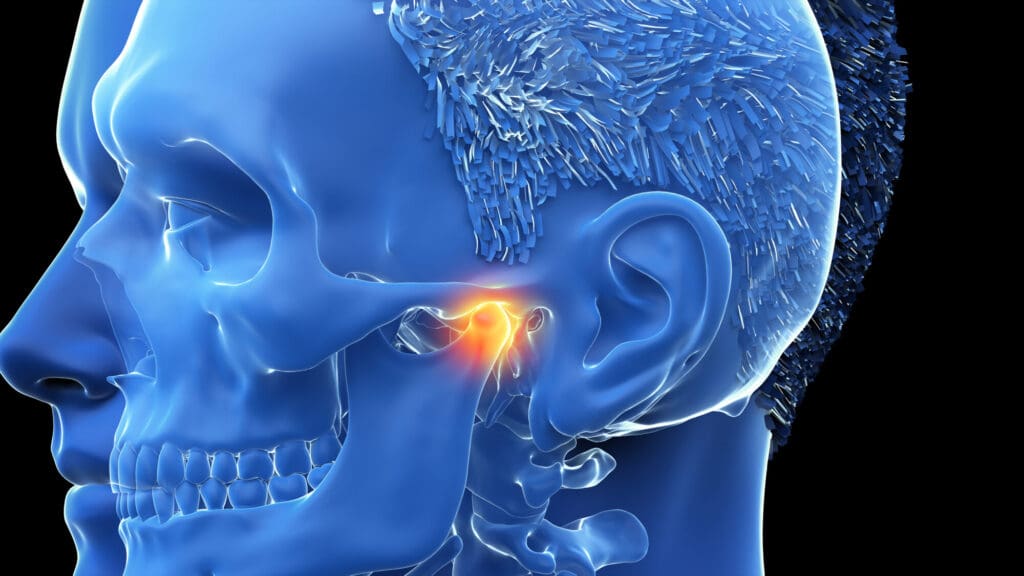
If your jaw clicks every time you eat, yawn, or talk, you’re not alone. Jaw clicking is one of the most common symptoms of teWhy Does My Jaw Click? Understanding Jaw Clicking and TMJ Pain
If your jaw clicks every time you eat, yawn, or talk, you are not alone. Jaw clicking is one of the most common symptoms of temporomandibular joint (TMJ) dysfunction, and it affects a significant portion of adults at some point in their lives. While many people assume the joint itself is the problem, the muscles surrounding the jaw, especially the pterygoid muscles, often play a significant role.
As physical therapists, we do not just treat where it hurts. We look at how the jaw moves and why it may not be moving efficiently.
What Causes Jaw Clicking?
One of the most common reasons for jaw clicking is a condition called disc displacement with reduction.
Inside each temporomandibular joint sits a small cartilage disc that cushions the joint and allows the jaw to glide smoothly. Ideally, this disc stays centered as your jaw moves.
Sometimes the disc shifts slightly out of position. As you open your mouth, the disc snaps back into place, creating the clicking or popping sound you hear. When you close your mouth, it may slip forward again, which is why some people notice a second, quieter click on the way down.
Many people have painless jaw clicking that never requires treatment. However, when clicking is accompanied by pain, stiffness, locking, or difficulty eating, it often indicates that the surrounding muscles and joint mechanics deserve a closer look.
Meet the Pterygoid Muscles
Deep inside your face are two muscles called the medial pterygoid and lateral pterygoid.
While they are not muscles you can see or easily feel, they have an important job:
- Guiding the jaw as it opens and closes
- Helping move the jaw forward and side to side
- Assisting with chewing and speaking
- Helping coordinate the movement of the TMJ disc
Think of them as part of the steering system for your jaw. When they are not functioning optimally, the jaw’s movement can become less controlled.
How the Pterygoid Muscles Contribute to Jaw Clicking
The lateral pterygoid has attachments to structures that help guide the jaw and influence movement at the TMJ.
When this muscle is not functioning well, whether because of weakness, poor coordination, fatigue, or pain inhibition, it may contribute to less efficient control of jaw motion.
Instead of moving smoothly:
- The jaw may deviate to one side as it opens
- The joint may experience increased stress
- Other chewing muscles begin to compensate
- Clicking may become more noticeable
- Pain may develop as tissues become irritated
It is important to understand that TMJ disorders rarely have a single cause. Muscle performance, joint mobility, posture, stress, clenching, previous injuries, and movement habits all interact to influence symptoms.
Can Weak Jaw Muscles Cause Pain?
Yes, but usually not directly.
Weak or poorly coordinated muscles often lead to compensation. Imagine driving a car with slightly misaligned steering. You can still get where you are going, but other parts of the vehicle begin working harder.
The same thing happens with the jaw.
If the pterygoids are not providing efficient control, larger muscles like the masseter and temporalis may become overworked. Over time, this can contribute to:
- Aching in the jaw
- Fatigue while chewing
- Headaches, particularly near the temples
- Facial pain
- Neck tightness
- Increased joint irritation
Signs Your Jaw Clicking May Need a Physical Therapy Evaluation
Not every click needs treatment. Consider scheduling an evaluation if you experience:
- Jaw clicking accompanied by pain
- Difficulty opening your mouth fully
- Jaw locking, either open or closed
- Pain while chewing
- Morning jaw soreness, which often points to nighttime clenching or grinding
- Frequent headaches near the temples
- Ear pain or a feeling of fullness in the ear, after other causes have been ruled out
- Neck pain that accompanies your jaw symptoms
How Physical Therapy Helps TMJ Pain and Jaw Clicking
Treatment goes far beyond simply massaging the jaw.
A physical therapist evaluates how your jaw moves, how your neck and posture contribute, and how the muscles around the TMJ function together. Because the jaw and the upper cervical spine share so much neurological real estate, treating one without the other often leaves results on the table.
Treatment may include:
- Retraining jaw movement patterns
- Exercises to improve muscular coordination and endurance
- Strengthening exercises when appropriate
- Manual therapy to improve joint and soft tissue mobility
- Treatment of the neck and upper back
- Postural training
- Dry needling, when clinically indicated
- Education on clenching, grinding, and activity modification
Research consistently supports exercise and conservative management as effective first line treatments for many TMJ disorders.
What to Expect at Your First TMJ Appointment
At Dynamic Physical Therapy in River North, every visit is one on one with your physical therapist. Your first appointment typically includes:
- A thorough history. We ask about your symptoms, your sleep, your stress, your dental history, and your daily habits, because all of them influence the jaw.
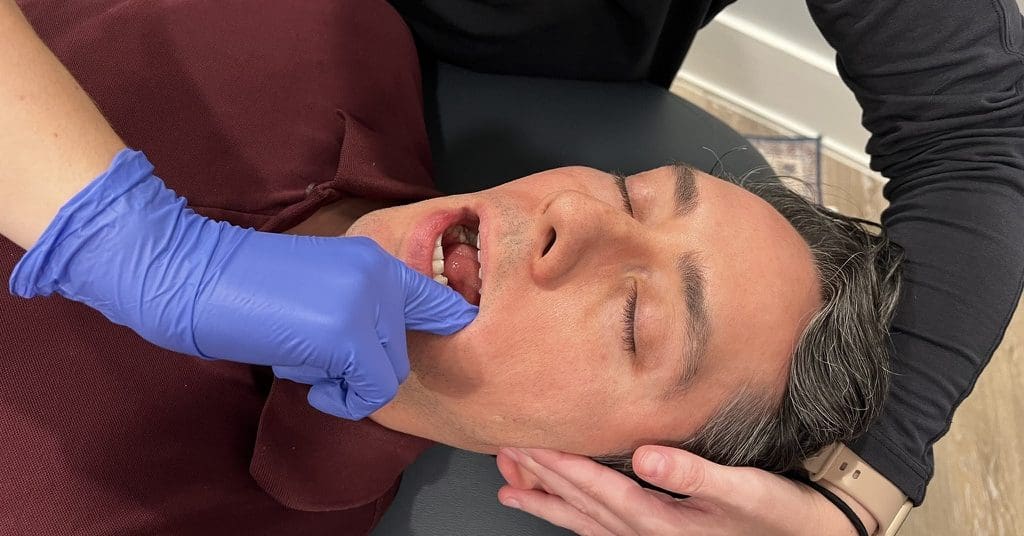
- A movement assessment. We measure how far your jaw opens, watch for deviation, and assess how your neck and upper back are contributing.
- A hands on exam. We assess the joint itself and the muscles that control it, including intraoral assessment when appropriate and with your consent.
- A plan you leave with the same day. You will go home with an understanding of what is driving your symptoms and specific exercises to start on.
Frequently Asked Questions About Jaw Clicking
Is jaw clicking without pain something to worry about? Usually not. Painless clicking is common and often does not require treatment. It is worth an evaluation if the clicking is new, worsening, or accompanied by pain, locking, or limited opening.
Can physical therapy stop my jaw from clicking? Physical therapy often reduces or eliminates clicking, but the more reliable goals are decreased pain, improved jaw motion, and easier chewing. Some patients keep a painless click and feel completely fine.
Should I see a dentist or a physical therapist for jaw pain? It depends on the driver. If your symptoms involve tooth pain, bite changes, or you have been advised to consider a night guard, start with your dentist. If your symptoms involve muscle pain, limited motion, headaches, or neck pain, physical therapy is a strong first step. Many patients benefit from both, and we coordinate care with your dentist when needed.
Do I need a referral to see a physical therapist for TMJ pain in Illinois? Illinois allows patients to begin physical therapy without a physician referral. You can schedule an evaluation with us directly.
How long does TMJ physical therapy take? Many patients notice meaningful change within a few weeks. A typical plan of care runs four to eight weeks depending on how long symptoms have been present and what else is contributing.
You Do Not Have to Live With Jaw Clicking
Not every jaw click needs treatment, but pain is your body’s way of saying something is not working as efficiently as it should.
Improving the function of the muscles that guide your jaw, including the pterygoids, can reduce strain on the joint, improve movement quality, and help decrease pain. Because TMJ disorders are multifactorial, the best treatment addresses the entire system rather than focusing on just one muscle.
TMJ Physical Therapy in River North, Chicago
If jaw pain has been limiting your ability to eat, speak comfortably, or enjoy daily life, a physical therapy evaluation can help identify the underlying contributors and create a personalized treatment plan to get you moving, and chewing, comfortably again.
At Dynamic Physical Therapy, every appointment is one on one with a licensed physical therapist. No aides, no double booking, no rushing.
If you could benefit from learning more about TMJ pain/clicking and strengthening your muscles, schedule an appointment here, call us at 312-643-1555, or email info@dynamic-pt.com.
Dynamic Physical Therapy • https://dynamic-pt.com • 220 W Huron St Suite 2004, Chicago, IL 60654